A Comparative Look at Internet Shutdowns in Iran: 2019, 2022, 2025, and 2026
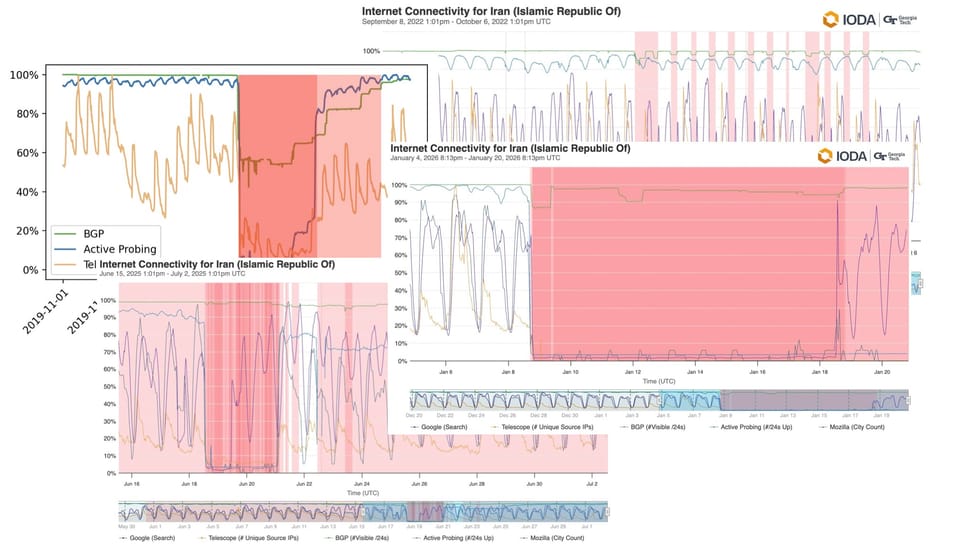
On January 8th, 2026, the Iranian regime implemented an Internet shutdown amidst national protests. This shutdown is the most sophisticated and most severe in Iran’s history. IODA's longitudinal view of global Internet connectivity provides insight into the Iranian regime’s developing sophistication in controlling information and shutting down the Internet in Iran.
To understand how the regime shuts down the Internet and how this has changed over time, it is important to understand how IODA measures Internet connectivity. It is also important to note that IODA measures global connectivity, or in this case, Iranians’ connectivity to the global Internet, as opposed to Iranians’ connectivity to their domestic internet, the National Information Network (NIN). To measure this requires running measurements inside the country, which could be highly risky for any individual involved, as this would be seen as a seditious act.
IODA measures Internet connectivity through signals related to Internet infrastructure. It currently makes use of three measurements: Border Gateway Protocol (BGP), Active Probing, and Telescope.
- Routers are responsible for directing traffic to and from networks through BGP or routing announcements. If routers stop making these announcements, a network will disappear from the global Internet. Every 5 minutes IODA compares updated Internet routing data from public data collection projects.
- IODA actively measures the responsiveness of networks through Active Probing. To create the Active Probing signal, IODA continuously pings devices in tens of thousands of networks around the globe. Most devices are designed to automatically respond to these pings by echoing them back to the sender. IODA collects these responses and labels networks as connected/active. We probe ~4.2M /24 blocks at least once every 10 minutes.
- Telescope captures a sort of Internet background noise traffic generated by millions of Internet hosts worldwide. We analyze and filter raw traffic data from the Merit Network Telescope and then compute the number of unique source IPs per minute.
Bloody November 2019 Shutdown
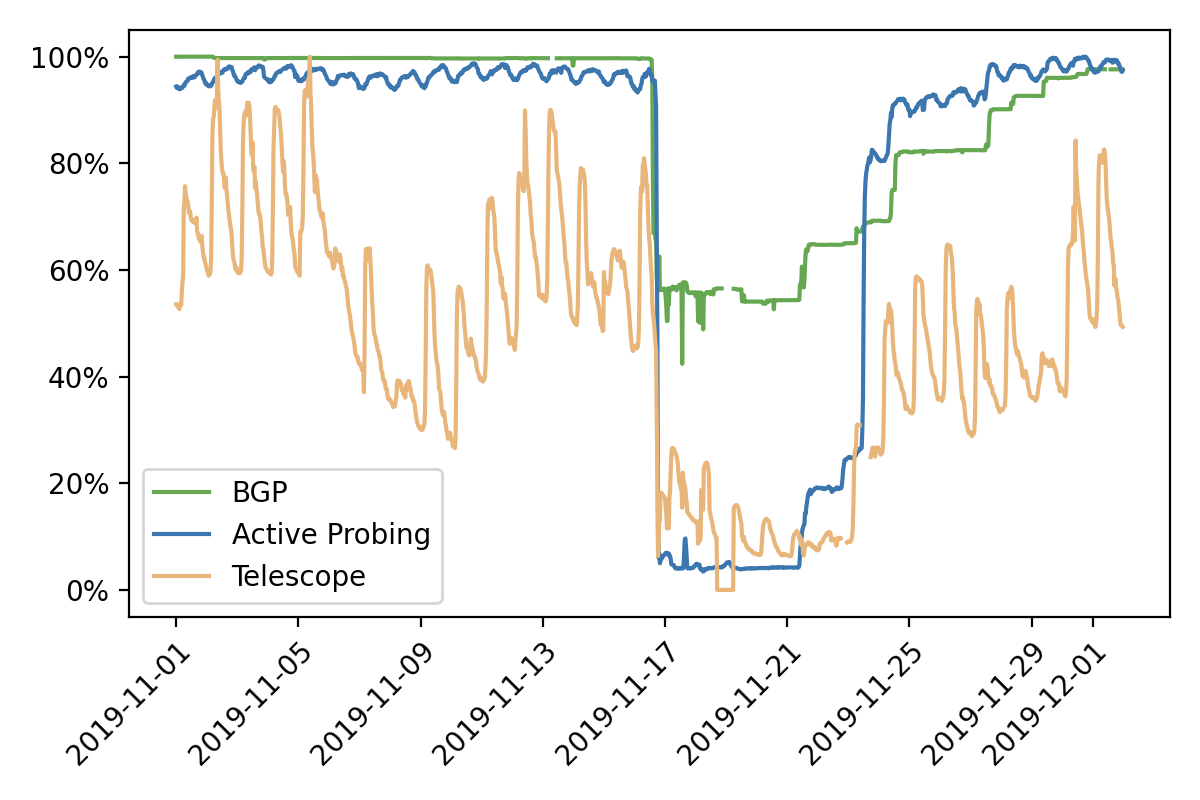
The first nation-wide shutdown that IODA observed in Iran was during Bloody November in 2019. During this shutdown, the primary method of implementation was through the withdrawal of routing announcements. This is considered a “blunt force” tool that is less sophisticated because the Internet essentially goes dark; no connectivity is possible for networks implicated. As documented by Amnesty International, this darkness created a “web of impunity” allowing for violation of international human rights law without any transparency.
From the evening of November 16, 2019 to the morning of the 21st, Iranians experienced a near complete Internet shutdown. Differences in signal-drop-patterns among the three IODA data sources demonstrate the regime’s adoption of diverse disconnection mechanisms and large differences in the timing of their execution by various Iranian Internet Service Providers (ISPs).
Censorship measurement groups reported that during the 2019 blackout, most Iranians still had access to the NIN. OONI measurements (which require Internet connectivity) were collected from multiple networks inside Iran between November 16-23, 2019, indicating that the Internet blackout was not total.
Women, Life, Freedom Movement 2022 Shutdown
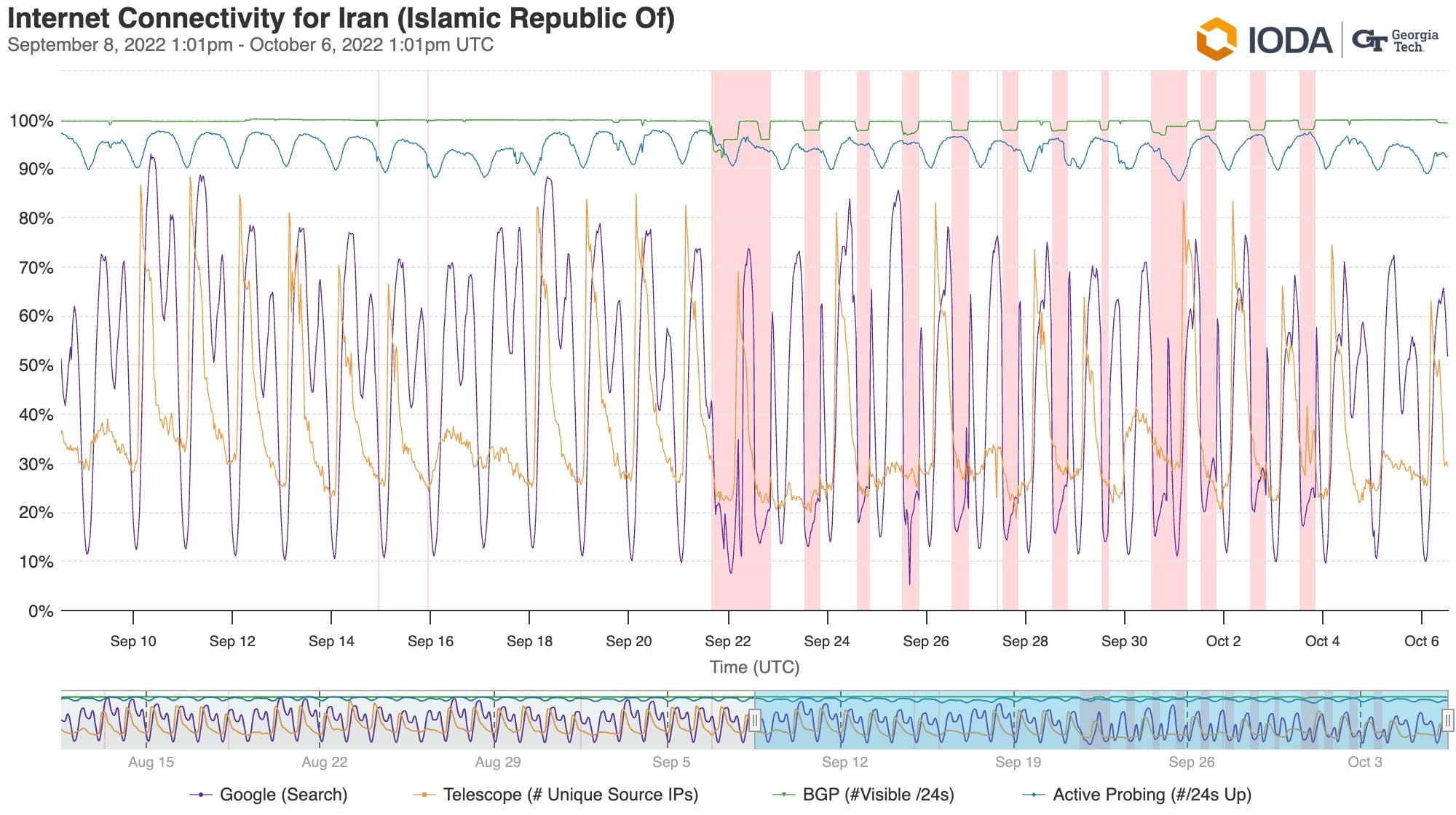
In September 2022, The Women, Life, Freedom protests erupted after the killing of Zhina (Mahsa) Amini in state custody. To suppress the nation-wide mobilization without exacting a high cost, the regime implemented nightly shutdowns affecting mobile networks only. These nightly shutdown curfews were visible in IODA's Routing Announcements and Active Probing signals. Keeping fixed-line Internet connections online limited the impact of these shutdowns to mitigate economic, political, and social cost of an Internet shutdown. These nightly Internet curfews lasted around two weeks and culminated in around 100 hours of mobile shutdowns. During this time the regime implemented other forms of censorship, specifically, blocking applications and various Internet protocols to further control the information environment and to prevent access to circumvention technology.
Israel-Iran War 2025 Shutdown
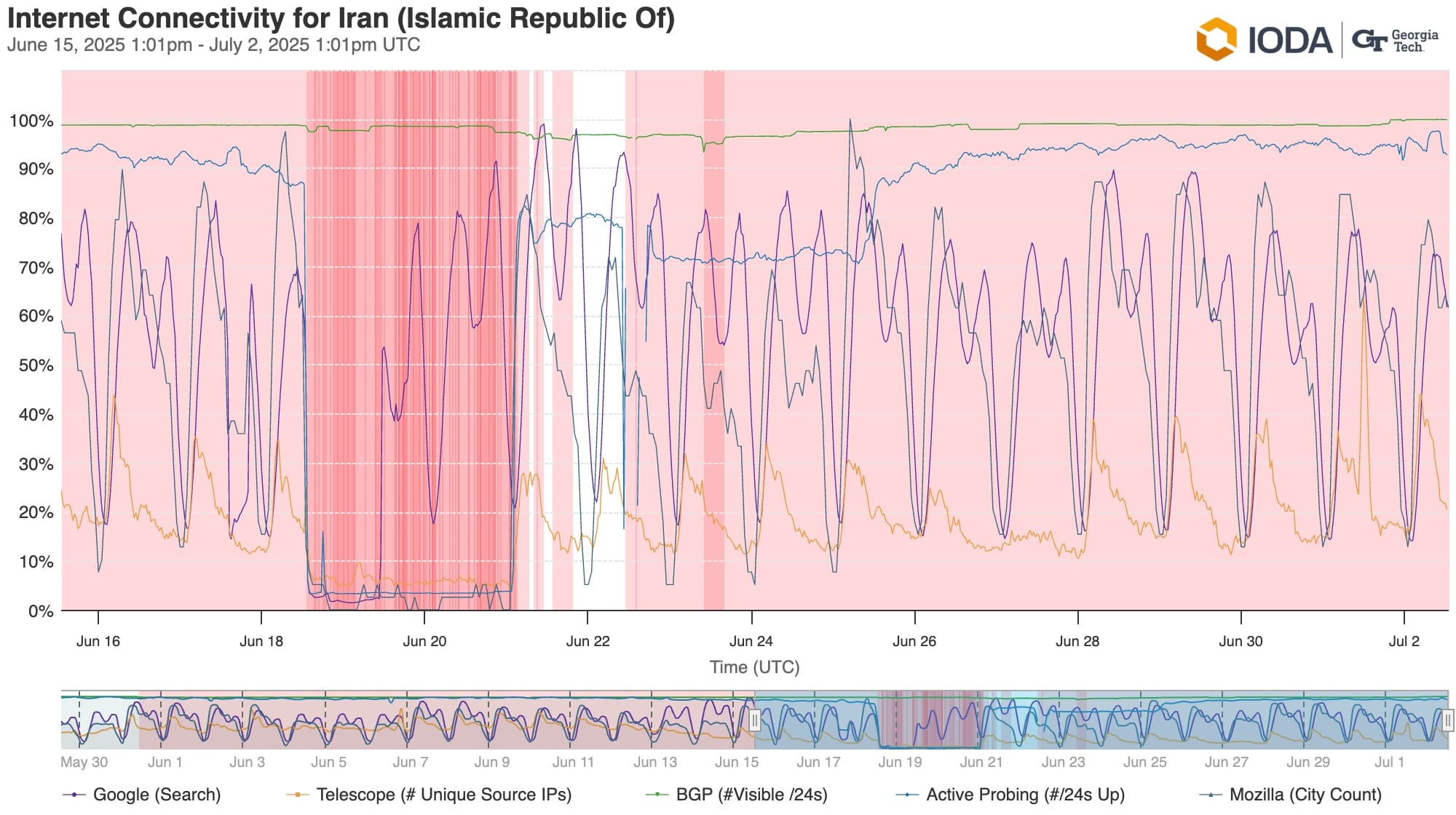
In June 2025, the Israel-Iran War began and IODA observed initial degradation in Internet connectivity which is often present during times of conflict when Internet and power infrastructure is impacted by missile attacks. The Iranian regime shutdown the Internet over 4 days and cited national security as the motivation. This time, BGP or Routing Announcements were not used to implement the shutdown. IODA measurement data shows that BGP was largely un-impacted. Instead, the government used various techniques to shut off Iran’s connectivity with the global Internet, while allowing specific, sanctioned access via the NIN in a policy called whitelisting. Organizations that support digital human rights in Iran report that Iranians were able to circumvent the shutdown using various VPNs and censorship resilient technologies built for autocratic, closed environment contexts.
January 2026 Shutdown
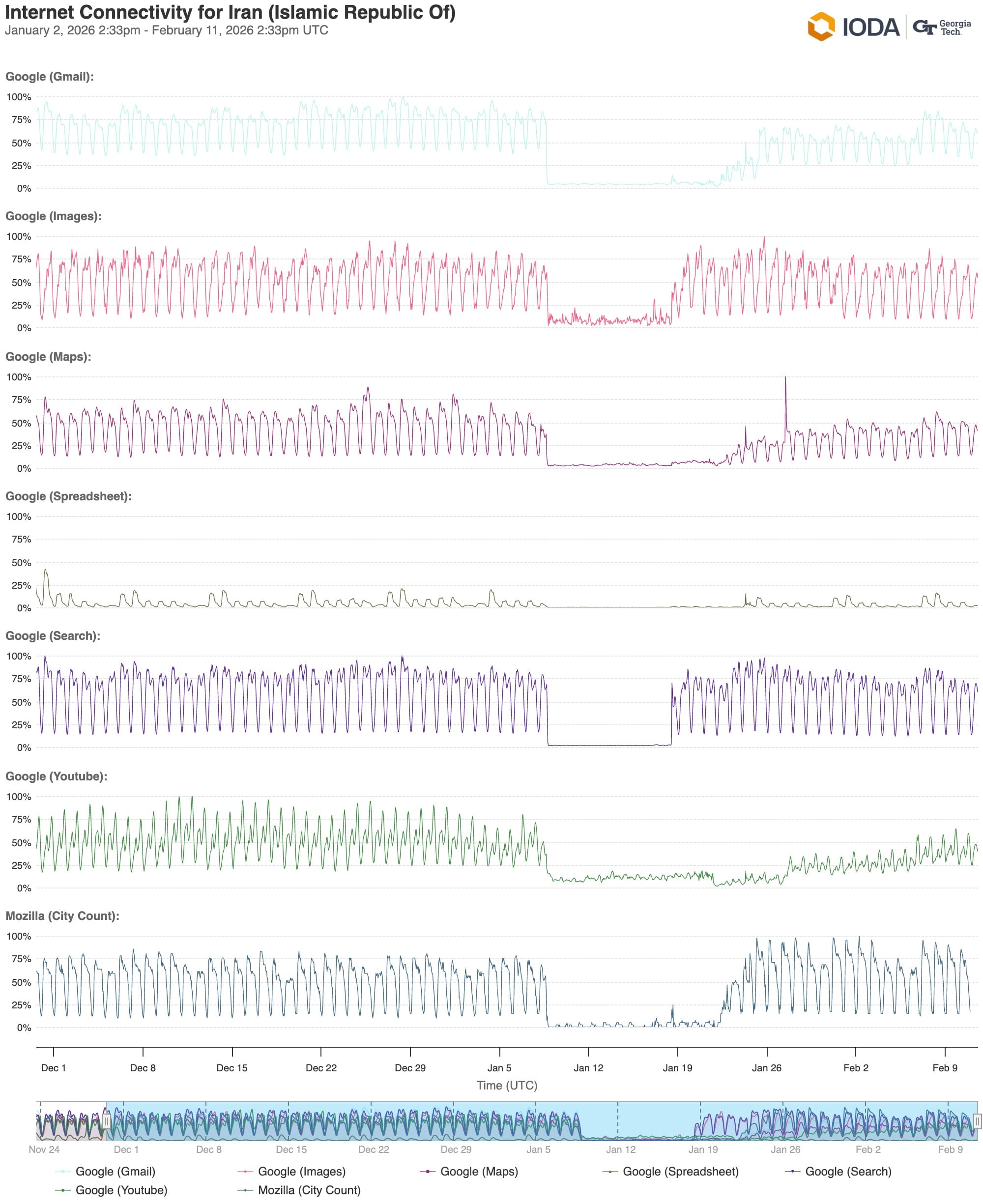
On December 30th, 2025, the IODA team received reports of Internet disruption amidst the start of nation-wide protests largely motivated by the rise in cost of living. On January 8th at 8:00 PM local time (Iran Standard Time), the Iranian regime shut down the Internet. IODA measurements show a nominal amount of responsiveness to our active probing (~3%), which could be an artifact of our measurements or lingering connectivity for whitelisted access provisioned to specific users (e.g. Iranian government actors and services or part of the infrastructural "border" of Iran's Internet controlled by the government). Outside of very limited whitelisted connectivity, digital human rights groups report severely limited access to the Internet both internationally and domestically. This includes limited, intermittent ability to make phone calls via landlines. This shutdown evokes the Bloody November Shutdown of 2019 in that it has been ordered during a time of protest with mass civilian casualties.
However, unlike Bloody November, routing announcements are not the primary form of implementation, again showing an increased sophistication in how the Iranian regime implements shutdowns and controls the information environment. Project Ainita reported that the the shutdown appeared rushed in its implementation since it took down the NIN and whitelisted SIM cards, which remained up in the 2025 shutdown during the Israel-Iran war.
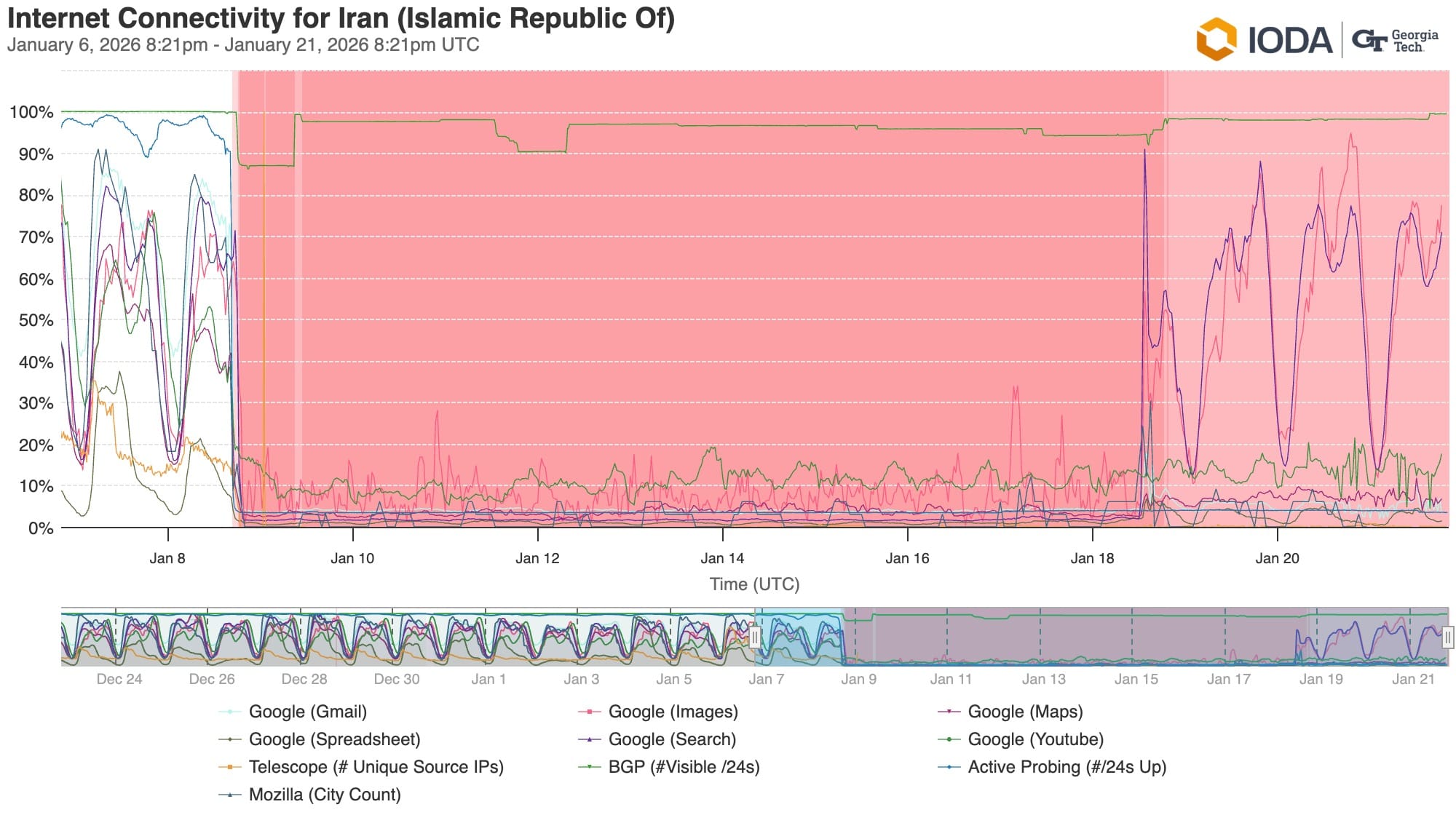
On January 18th, several measurement groups (IODA, Cloudflare Radar, Kentik) reported observing signs of restoration of Internet connectivity in Iran. While the initial recovery in connectivity was short-lived, the recovery of access to whitelisted services via the NIN appears to have recovered, as visible in the recovery of Google Search (purple line visible in the IODA graph above) and Google Images (pink line visible in the IODA graph above). Since January 18th, it appears the Iranian regime is turning back on whitelisted access via the NIN.
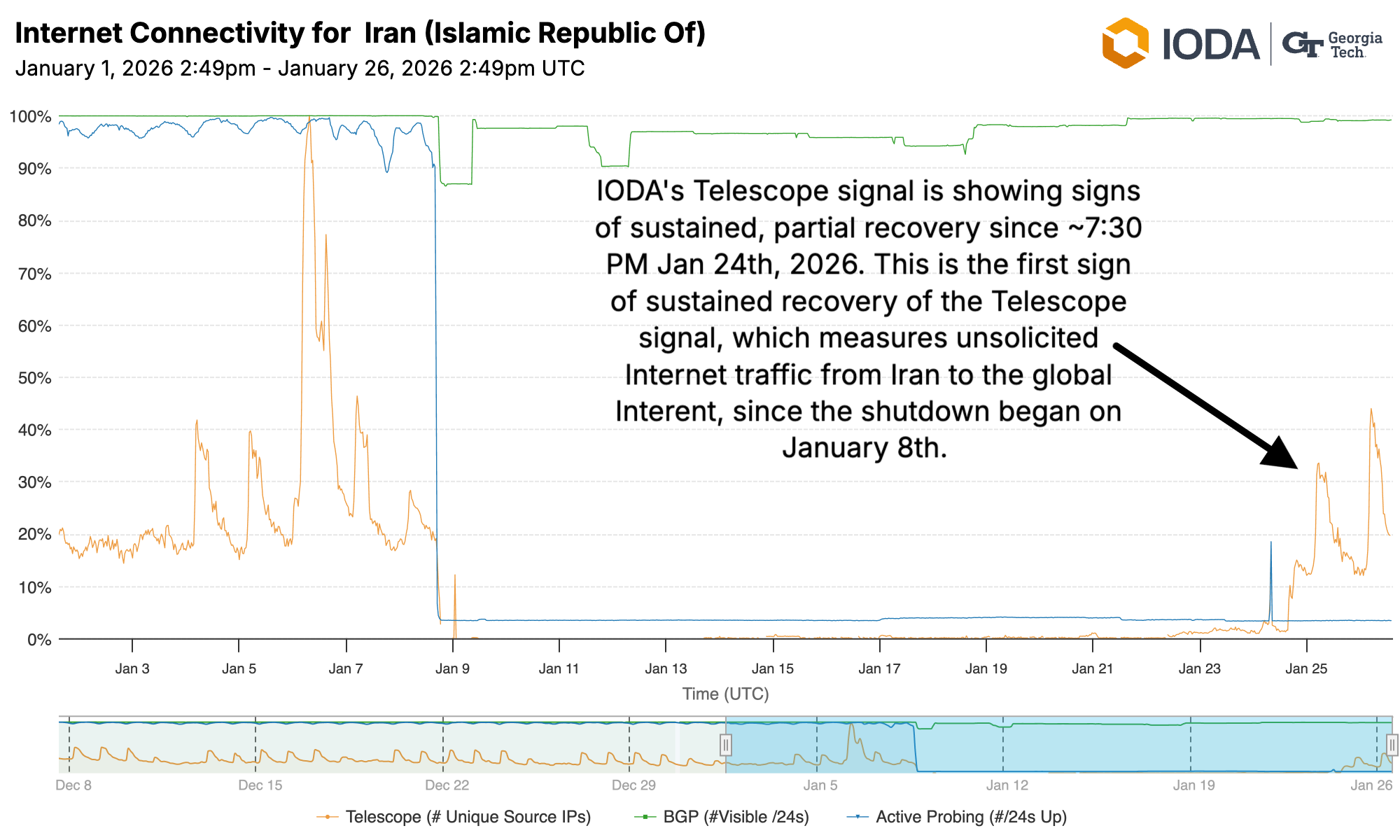
On January 24th, 2026, IODA began seeing initial signs of Iran's return to connectivity to the global Internet via the Telescope signal. A sustained increase in the telescope signal indicates that Iranian devices are connected to the global Internet because they are producing unsolicited Internet traffic captured by the Telescope.
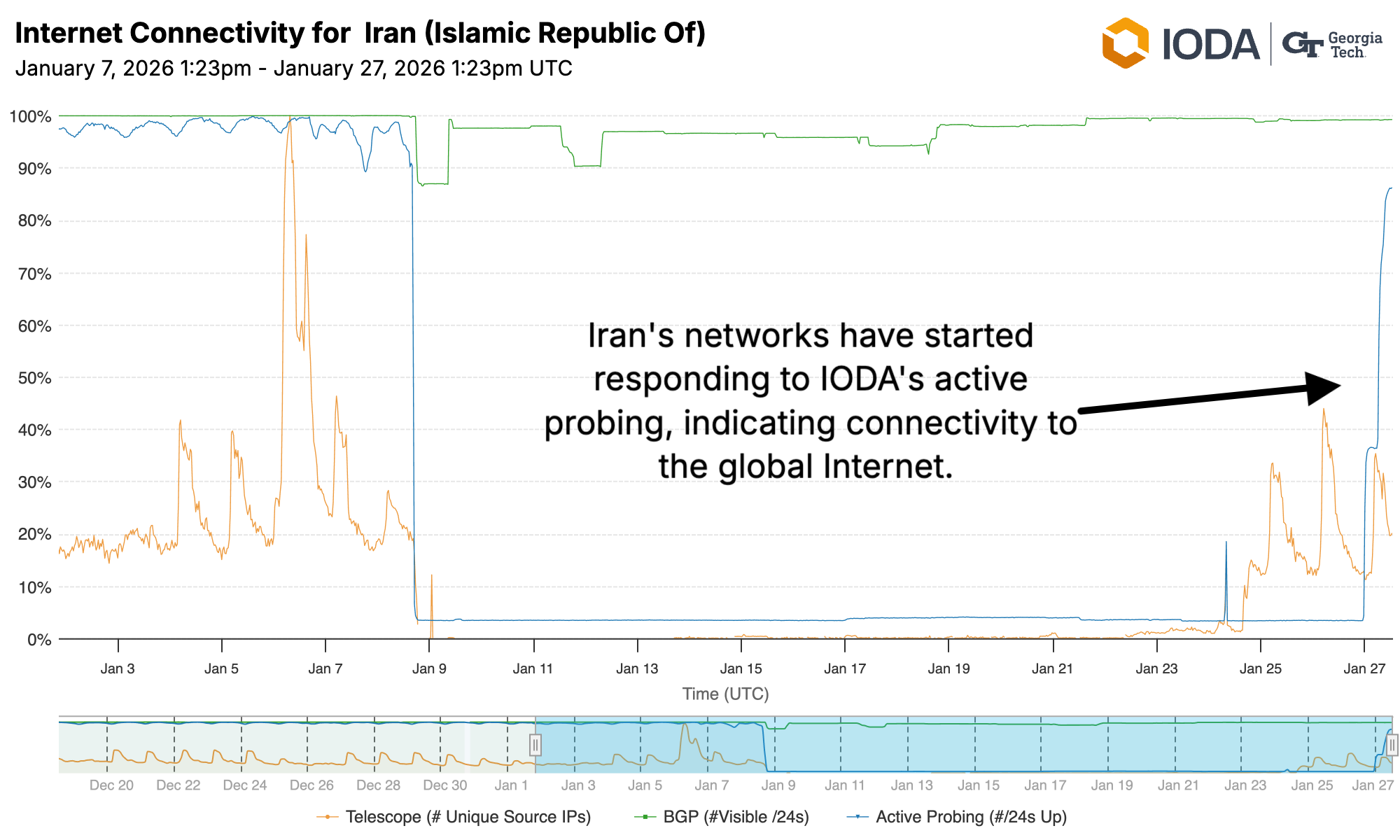
Later, on January 27th, IODA's Active Probing signal showed a sharp recovery. Meaning, devices on Iranian Internet networks began responding to IODA's ping, indicating their connectivity to the global Internet.
However, google product usage data shows varied return to Internet usage in Iran. Meaning, while Internet infrastructure in Iran may be connected to the global Internet, Iranian Internet users are not experiencing a return to the Internet they experenced prior to January 8th. This is most visible in lower levels of usage of Google's YouTube, Gmail, and Maps.